
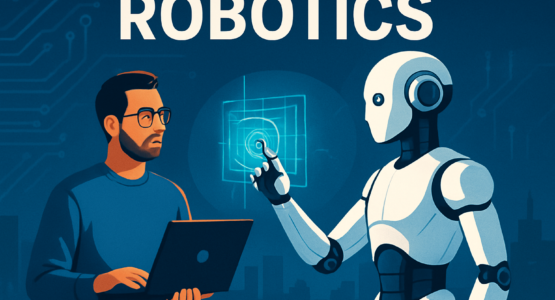
Remember when a smart speaker that could play your favourite song or a thermostat that learned your schedule felt like the future? Those early devices, like Amazon’s Alexa and Google’s Nest thermostat, were impressive for their time. But the bar for what we call ‘smart’ has been raised—and it’s been raised astronomically. We’re now entering the era of Physical AI, where robots don’t just process language but actually perform tasks: household chores, assembling aircraft, and heavy lifting in factories. And here’s the thing: Large Language Models (LLMs) alone aren’t up to the job.
Let me paint you a picture. I remember setting up my first smart bulb; it felt like magic to control lights with my voice. But that’s exactly the problem—it was all about voice. Today, we’re talking about robots that can fold laundry, navigate cluttered rooms, or even help build a car. That’s a whole different ballgame. Physical AI isn’t just a fancy term; it’s a paradigm shift. It’s the difference between asking a computer to write a poem and asking it to clear your dinner table without knocking over a glass.
Why LLMs Fall Short in the Real World
LLMs are brilliant at language processing. They can write essays, answer questions, and hold conversations. But they lack a fundamental ability: understanding and interacting with the physical world. A chatbot doesn’t know what a room looks like, how to navigate a hallway, or what to do when a toy is left on the floor. That’s where world models and spatial intelligence come in. These are the technologies that let AI comprehend real-world spaces—rooms, hallways, factories, construction sites—and act within them.
Think about it this way: if you ask an LLM to “grab the red cup from the kitchen counter,” it might generate a grammatically perfect sentence about grabbing cups, but it has no clue where the kitchen is, what a cup looks like, or how to move its “arm” to pick it up. Physical AI, on the other hand, needs to map the environment, identify objects, and execute actions in real-time. It’s a completely different beast.
World models focus on simulating real-world environments. This is crucial for gaming, where virtual worlds need to feel realistic, but it’s even more important for robotics. In robotics, understanding physical space involves three layers: perception (identifying what’s around), scene understanding (interpreting how objects are arranged), and contextual intelligence (knowing what action to take). For example, a robot in a factory needs to see a conveyor belt, understand that boxes are stacked in a certain way, and decide to pick one up without knocking others over. That’s a lot of heavy cognitive lifting, and it’s way beyond what an LLM can do.
The Messy Reality of Dynamic Environments
Operating in dynamic environments presents real challenges. Unexpected obstacles are common: a child’s toy on the living room floor, spilled materials in a warehouse, or a person walking into a robot’s path. These are situations where an LLM would be useless because it has no sense of space or movement. Physical AI must handle these on the fly. It’s not just about avoiding obstacles; it’s about understanding the context. A toy on the floor might be something to step over, but a spilled chemical in a factory is something to avoid entirely. The AI needs to know the difference.
I’ve seen videos of early robot vacuums getting stuck on a single sock. It was both hilarious and frustrating. Today’s Physical AI systems are light-years ahead, but they still struggle with nuance. A sudden change in lighting, a new piece of furniture, or a pet moving across the room can throw them off. It’s a constant game of catch-up with the physical world. And that’s why we’re seeing a shift in emphasis.
From Virtual Reality to Augmented Reality and Beyond
The emphasis is shifting away from virtual reality and metaverse platforms toward augmented reality (AR). AR integrates digital intelligence with the physical world, overlaying information onto what we see. But for AR to work well, it needs a deep understanding of space. It’s not just about placing a digital object on a table; it’s about knowing the table’s size, the lighting, and how the object should interact with the environment. Physical AI is the engine that powers this understanding.
Translating continuous video into intelligence is tough for computers. They struggle with nuances like lighting changes or new objects appearing in a space. A human can instantly adapt, but a computer needs sophisticated models to handle these variations. This is where edge intelligence becomes important. Real-time Physical AI processing on devices—like a robot’s onboard computer or a smart glasses processor—allows for immediate responses without waiting for cloud servers. Without edge intelligence, you’d have a robot that hesitates every time something changes, which is a recipe for disaster in a fast-paced environment.
Physical AI systems need to balance on-device processing for speed with cloud computation for long-term memory and ambient intelligence. For instance, a robot might use its local processor to avoid an obstacle instantly, but rely on the cloud to remember the layout of a building over time. This hybrid approach is key. It’s like having a quick reflex for immediate dangers, but a longer-term memory for planning and navigation. The latest thinking from experts suggests this balance is crucial for making Physical AI truly practical.
Hardware: The Unsung Hero of Physical AI
Advancements in hardware are essential. Custom chips optimized for Physical AI are being developed as robots and wearables become more common. These chips need to be efficient, not just powerful, because a robot can’t carry a supercomputer around. The key to real-world AI isn’t raw computing power; it’s efficiency, context, and spatial understanding. You can’t just throw more processing cores at the problem—you need chips that are designed specifically for the kind of real-time, low-latency processing that Physical AI demands.
The transition from digital simulation to real-world action in Physical AI requires architectures that can perceive, understand, and act intuitively. This is a complex task, demanding significant advancements in technology and our understanding of the physical environment. LLMs were a great start, but they’re not enough. The future belongs to AI that can see, move, and interact with the world around us. And honestly, that’s a future I can’t wait to see unfold—even if it means my robot will have to learn to navigate around my dog’s toys.
Check out more AI and Tech related Articles here.
