
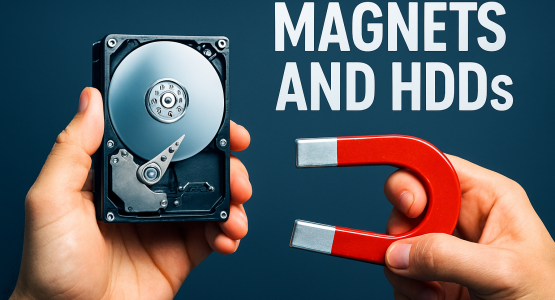
Magnets and hard drives have never exactly been best friends. It’s one of those tech questions that refuses to die: can a magnet really wipe out everything on your drive? The honest answer is a frustrating “it depends.” Because not all drives work the same way, and not all magnets pack the same punch.
The Real Risk: Can Magnets Damage Hard Drives?
Let’s start with the classic spinning disk. Traditional hard disk drives, or HDDs, store your data on platters coated with a magnetic material. Every single bit of data is basically a tiny magnetic orientation, a little north-south arrow pointing one way or the other. So yes, in theory, an outside magnetic field could nudge those arrows out of place and corrupt your files.
But here’s the catch. That doesn’t mean the souvenir magnet stuck to your fridge is some kind of data assassin.
Modern HDDs come wrapped in shielding designed to shrug off the everyday magnetic noise around us. Think about the small magnets hiding in phone cases, speakers, and tablet covers. They’re simply not strong enough to punch through the casing and cause trouble. You’d need something far more powerful, pressed right up against the drive, before anything interesting happens.
I remember a friend who once left a magnetic phone mount sitting on top of an old external drive for a week. Nothing happened. Not a single corrupted file. That’s the reality for most people.
When Magnets Actually Become a Threat
Industrial-strength magnets are a different beast entirely. Neodymium magnets, the kind that snap together hard enough to pinch your fingers, carry real power. Put one directly against an HDD and you’re asking for trouble.
Even then, though, the damage tends to be localized. A magnet rarely wipes an entire drive clean in one dramatic sweep. More often, you’ll see a handful of corrupted files or bad sectors rather than total data loss. It’s messy, not apocalyptic.
So for anyone who has ever panicked after accidentally leaving a magnet near a laptop, take a breath. In typical consumer settings, the odds of accidental damage are remarkably low. Most of us never need to worry about whether magnets damage hard drives during normal, everyday use. The magnetic fields floating around our homes and offices just aren’t strong enough to get through the drive’s casing and shielding.
There are exceptions, naturally. External magnetic fields from something like an MRI machine can absolutely wreck an HDD if the drive gets too close. But unless you’re wheeling your laptop into a hospital imaging room, that scenario isn’t on your radar. It’s extreme, not everyday.
What About SSDs? A Completely Different Story
Now things get refreshingly simple. Solid-state drives, or SSDs, don’t use magnetic storage at all. They tuck your data away in flash memory chips, which makes them essentially immune to magnetic interference. A magnet won’t touch an SSD, no matter how absurdly strong it is. That’s a crucial distinction when you’re weighing up magnetic risks.
Curious about the deeper physics behind all this? There’s a solid breakdown over at Head Topics that digs into the nitty-gritty.
Degaussing: The Only Surefire Way to Erase an HDD
If you genuinely want to erase a hard drive with magnetism, you’d need specialized degaussing equipment. This gear applies an extremely strong magnetic field to scramble the platters beyond recovery. It’s not a job for the magnet you keep in your toolbox drawer.
Degaussing belongs to the world of secure data destruction, the kind used by organizations that need to guarantee old drives are unreadable. It’s deliberate, industrial, and nothing like casual experimentation. In other words, the average person has zero practical use for it.
Should You Keep Magnets Away From Your Drives?
Absolutely. It’s just common sense. Even though the risk is low, there’s no upside to tempting fate. A little distance goes a long way, and it costs you nothing to be careful.
Ask yourself this: why store a powerful magnet right next to the device holding all your photos, documents, and work files? You wouldn’t leave a glass of water balanced on your keyboard, would you? Same logic applies here.
On the other hand, don’t lose sleep over it either. The everyday magnets in your life, the ones clinging to your fridge or buried inside your headphones, aren’t a threat to a modern HDD. Shielding does its job, and the physics simply don’t line up for accidental damage in normal conditions.
The bottom line? Magnet damage to hard drives is possible, but it’s rare and usually avoidable. For most people going about their day, the threat is negligible. If you work with powerful magnets, or you’ve got an old HDD gathering dust in a drawer, just be mindful about where you place things. Otherwise, relax. Your data is probably safer than you think.
Check out more AI and Tech related Articles here.
