
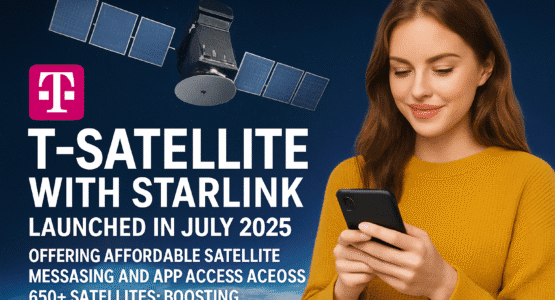
T-Mobile and Starlink: Revolutionizing Satellite Connectivity
In a monumental leap for satellite connectivity, T-Mobile’s T-Satellite service, powered by Starlink, officially went live in July 2025. This remarkable service brings messaging and app access to life through a network of around 650 Starlink satellites, gracefully orbiting over 200 miles above our heads. Imagine being in a remote area, miles away from the nearest cell tower, and still being able to send a message or check an app. That’s the lifeline this service provides, especially in places where traditional cell towers are either non-existent or knocked out by nature’s whims.
For those wondering about the cost, here’s some good news: If you’re on T-Mobile’s Experience Beyond plan, which kicks off at $100 a month for three lines, the T-Satellite service comes at no additional charge. Feeling a bit left out if you’re with AT&T or Verizon? Don’t worry. You can still hop onto the service for an extra $10 a month. This pricing strategy is a game-changer, making satellite connectivity something not just for the elite but for everyone across the U.S.
A Glimpse into the Growing Demand
During its beta phase, which started back in February 2025, T-Satellite saw nearly two million eager sign-ups, with daily users peaking at 30,000. Not surprisingly, T-Mobile customers lead the pack in Starlink direct-to-device (D2D) connections. AT&T users, however, weren’t far behind in expressing interest. This trend clearly underscores the thirst for reliable connectivity that goes beyond the reach of traditional cellular networks.
Initially, T-Satellite mainly supported text messaging and emergency 911 services. Fast forward to October 2025, and the service has grown leaps and bounds. Now, it supports app-based voice, video, and data services—think of popular tools like mapping, weather updates, social media, and even video chats. This evolution means users can stay connected and informed anywhere, even in places once deemed unreachable by regular cellular networks.
The Power of Collaboration
This venture between T-Mobile and SpaceX, which started in August 2022, cleverly uses a slice of T-Mobile’s airwaves to connect ordinary smartphones directly to Starlink satellites. Imagine the convenience—no extra gadgets or gizmos required. It’s a significant leap forward in satellite connectivity, making the process of staying connected simpler than ever.
While T-Mobile’s fixed internet speeds remain as they are, SpaceX is on a mission to boost direct-to-device data speeds. Their goal? To reach speeds that rival 4G LTE. This ongoing development promises an even more robust and reliable satellite-based mobile connectivity experience in the future.
Competition and Future Outlook
It’s not just T-Mobile in the race. Competitors like AT&T and Verizon are diving into satellite partnerships too. Companies such as Skylo and AST SpaceMobile are working on similar direct-to-device services. Although their rollouts are slower, they’re making strides. For example, Verizon is already offering satellite texting through Skylo on newer phones. Additionally, AST SpaceMobile is gearing up to launch up to 60 satellites by 2026 for sporadic satellite connections.
The T-Satellite service is a beacon for bridging the connectivity gap between bustling urban centers and remote corners of the country. It’s a safety net for those in the wilderness or in rural communities where traditional cell service is still a distant dream. By providing reliable satellite connectivity, T-Mobile and Starlink are reshaping how we think about staying connected, no matter where we are.
In conclusion, T-Mobile’s T-Satellite service, powered by Starlink, stands as a pivotal advancement in mobile satellite connectivity. It offers affordable and reliable access to messaging and app services across the U.S., particularly in underserved regions. This partnership not only enhances everyday communication but also plays a crucial role in emergencies, marking a new era in the future of connectivity.
Check out more AI and Tech related Articles here.
